
Description
Transcript
Most people misjudge Bitcoin because they have never been given a working definition of wealth. David Deutsch's is the set of transformations you could perform without generating new knowledge, and it explains why a million dollars on a deserted island buys almost nothing, why no fortune in 1924 could buy a cure that didn't exist yet, and why holding a fixed share of a ledger gets more valuable as other people solve problems.
Episode Summary
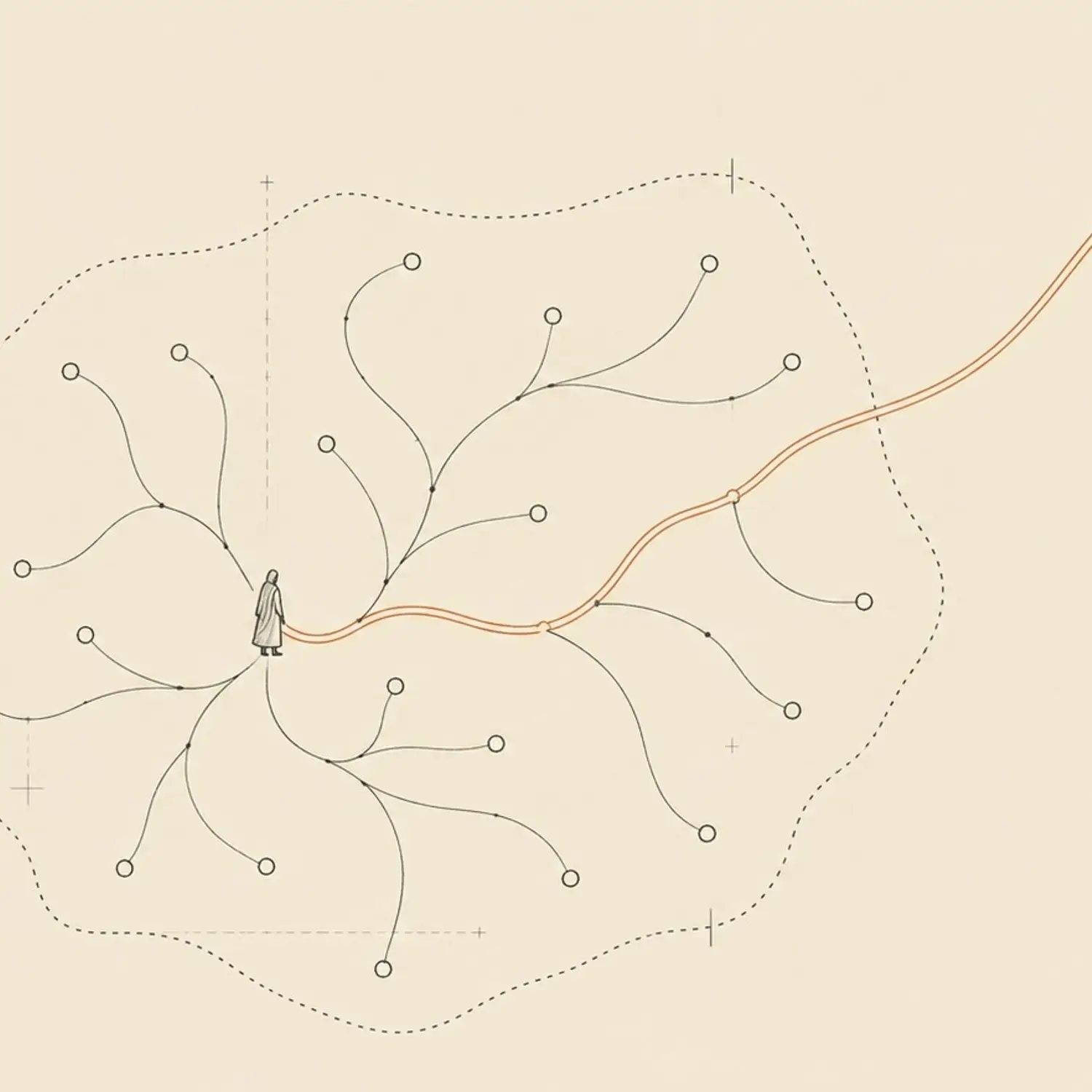
David Deutsch defines the wealth of an entity, in his 2012 paper Constructor Theory, as the set of transformations it could perform without generating new knowledge. That sentence is the best definition of wealth this show has come across, and the episode argues that its absence is what holds most people back from understanding what Bitcoin will do to the extended order, Hayek's name for the collective of people who generate and share knowledge they could never hold individually. Without a definition, money looks like a score to be accumulated. With one, money becomes a tool, and a tool can be judged by what it lets its holder do.
Consider a person stranded on a deserted island with a million dollars. They may know how to bake bread or dig a well, but with no oven, no shovel and no novel arrangements of matter to hand, they can transform almost nothing, and so they are not wealthy. Hand someone a shovel without the knowledge of what digging is for and the result is the same, since an arrangement of matter nobody knows how to employ opens no new phase space. Knowledge also changes how tools are judged. Two shovels with the same blade, one with a six-inch handle and one with a six-foot handle, look equally good to someone who has never dug a hole. The digger knows the long handle spends less energy for the same hole, and finishing in three blocks of time instead of six leaves three blocks, and the energy that would have gone into them, free for other transformations. Time works much like Bitcoin's blocks: standing in one spot to dig commits that moment and removes every future that would have followed from standing a step to the left, just as confirming a transaction removes the branches it would have opened had it stayed in the mempool.
The qualifier at the end of Deutsch's sentence carries the argument. Generating new knowledge is creativity, a separate quantity, and wealth is a set of transformations, which is why it resists being reduced to a single number. Calvin Coolidge Jr., the sixteen-year-old son of a sitting American president, died of blood poisoning from an infected blister on 7 July 1924. His family had about as much money and access as anyone alive, and there was nothing to buy, because Alexander Fleming's report of penicillin's antibacterial action was still years away. Once someone had built the road to that phase space, money could pay for the trip; before then, no amount of it could. Wealth describes the possibilities that already exist, and new knowledge is what enlarges them.
Explanatory knowledge is what gives people an advantage over replicative knowledge, the slower kind evolution produces. Evolution has to build fifty birds with fifty slightly different wings and let the losers die. A mind can conjecture why one design should outperform the rest, criticise the guess, and build only the survivor, running the whole competition in imagination at almost no energy cost. The episode returns to the image of the potter's jug: creativity takes the available information, arranges it into a new order and constrains it so it can't drift anywhere else, which makes a new region of possibilities reachable. Knowledge that does this persists only if it can travel from one physical medium to another while staying hard to vary, and most of what anyone uses each day was inherited this way from people they will never meet.
Wealth needs the tool and the knowledge of what it's for
That inheritance also explains how holders of Bitcoin get wealthier. In the extended order a person earns money by solving other people's problems: if a task would cost someone three blocks of time and a certain amount of energy and you can do it in one, they will willingly hand over a slice of what you saved them. The highest-paid solutions are the ones that keep working without their author, carried in a book, a podcast or a stranger's conference talk. Somewhere, every day, people are producing those solutions, and the set of transformations the extended order can reliably perform keeps growing. The show's older name for that growing pie is TASOE, the total accessible supply of energy. Bitcoin's supply doesn't grow with it. The percentage of the ledger a holder owns stays fixed while the capabilities that percentage commands expand. Deutsch has said nothing about Bitcoin, and this application of his definition is the show's own extension.
The episode also records an error. The early thesis held that Bitcoin had perfected money and coordination, and that people would recognise it. Bitcoin turned out to be the perfect tool for the people who already wanted one. Most people are underwater, unable to think ten days out, let alone ten years. Professionals who manage other people's money face a different trap: beating a colleague by two points on a product nobody questions earns a bonus, while holding a volatile new asset through one bad year gets them fired, and the extra thirty percent they forgo belongs to someone else anyway. Michael Saylor's refinery analogy points to the practical answer: give people the product they want and do the conversion for them. Debasement will keep pushing a few individuals toward the exits, and adoption will come from them long before it comes from the masses.
Maximising wealth therefore means maximising knowledge generation, and the recipe is old: property rights to encourage conjecture and free speech to permit criticism. Both are rare in practice because institutions lock in and stop accepting criticism, and every point of friction between knowledge generation and the extended order leaves everyone worse off. Knowledge also has to outlive the people who discover it. A life works much like a model's context window: understanding builds up through conjecture and criticism, and whatever isn't constrained into a durable, hard-to-vary form disappears when the window closes, so that someone else has to rediscover it at full cost. Every conversation with a large language model starts over unless it is pointed at a second brain that holds context between sessions, the situation of the film 50 First Dates. Rediscovery is waste, and a civilisation that keeps forgetting is less likely to persist against one that remembers.
The share stays fixed while what it commands keeps growing
Seen at the largest scale, most of the order in the universe so far came from structural knowledge, the formation of stars and the interactions of matter under physical law, and then from replicative knowledge, in which every branch has to survive before anything can be learned from it. Explanatory knowledge makes the same leaps with far less energy and fewer blocks of time, and its rate of order generation will keep accelerating. The people who open closed phase space for others will be paid willingly for the new transformations they make possible, and the money they will want is the one hardest to vary. That leaves the episode optimistic and pessimistic at once: confident that Bitcoin will keep operating as it has since inception, and doubtful that most people will recognise what it is in time. The short run will stay volatile, the long run is clear, and the opportunity is still open to anyone willing to do the work.
Timestamps
00:00 - What most people are missing: a definition of wealth
01:10 - Explanatory knowledge and the fifty wings evolution has to build
02:36 - The jug, the clay and reach
02:59 - A million dollars on a deserted island
03:47 - A shovel you don't know how to use
04:07 - Persistence: maintaining a unique arrangement
05:06 - Back to explaining Bitcoin: money as a tool
05:40 - Short handle, long handle
06:28 - Energy and blocks of time saved
07:04 - Time as blocks, and the futures a commitment removes
08:29 - Inherited knowledge and states that travel
09:04 - Easy to replicate, hard to vary
09:57 - Is more money the answer?
10:10 - Without generating new knowledge: wealth as a set
10:37 - Calvin Coolidge Jr. and the cure money couldn't buy
11:29 - Why holding Bitcoin generates wealth
12:01 - Getting paid for solving other people's problems
12:25 - Knowledge that keeps solving problems without you
13:50 - The perfect tool, for the few who want one
14:18 - People who can't think ten days out
14:46 - Career risk and other people's money
16:10 - Debasement and the forced-adoption thesis
16:58 - Moving fifty thousand dollars: fiat friction versus Bitcoin
17:43 - A few individuals looking for the exits
18:55 - TASOE: a fixed ledger over a growing set
20:01 - Property rights, free speech and lock-in
21:07 - AI and the context window
23:21 - 50 First Dates and the second brain
24:35 - Optimism and pessimism
26:36 - Structural, replicative and explanatory knowledge
28:17 - Who will hold the most Bitcoin
29:11 - Volatile in the short run, clear in the long run
Timestamps are approximate.
Topics Discussed
Wealth: what individuals and the extended order should be optimising for, and why most people misjudge Bitcoin without a definition of it
David Deutsch's definition of wealth as the set of transformations one could perform without generating new knowledge
The deserted island: why money without tools or knowledge transforms nothing
Tools judged by purpose: the short-handled and long-handled shovel
Time measured in blocks, and the futures a commitment removes
Wealth as a set of possibilities, and creativity as the act that enlarges it
Calvin Coolidge Jr. and the transformation no fortune could buy in 1924
Explanatory knowledge versus replicative knowledge: conjecture and criticism instead of fifty wings
Knowledge as states that travel, easy to replicate and hard to vary
Earning money by solving other people's problems, and solutions that work without their author
TASOE, the total accessible supply of energy, as the growing pie a fixed-supply ledger lays claim to
The early Bitcoin thesis and why most people don't want the perfect tool
Career risk for people managing other people's money
Property rights, free speech and institutional lock-in
The context window: knowledge that disappears unless it is constrained into durable form
Links & References
David Deutsch, "Constructor Theory" (arXiv:1210.7439, 2012; Synthese 190, 2013), section 3.9 on wealth
David Deutsch, The Beginning of Infinity (Allen Lane, 2011) on explanatory knowledge, creativity, and conjecture and criticism
Alexander Fleming, "On the Antibacterial Action of Cultures of a Penicillium" (British Journal of Experimental Pathology, 1929)
Calvin Coolidge Presidential Foundation, "Calvin Jr. Dies"
F. A. Hayek, The Fatal Conceit: The Errors of Socialism (University of Chicago Press, 1988) on the extended order
Karl Popper, Conjectures and Refutations: The Growth of Scientific Knowledge (Routledge, 1963)
Related Episodes
Episode #194 - States that Travel covers knowledge as arrangements that travel between substrates, and value as opening phase space for others.
Episode #183 - Capital in the 22nd Century treats wealth as embodied knowledge against wealth as a stock of things.
Episode #140 - The One Problem is the show's first use of Deutsch's framing of wealth as a repertoire of transformations.
Notable Pull Quotes
““Wealth isn’t a number, it’s a set.”*”
““No amount of money could have bought it the week before.”*”
““Money is just a tool inside of that system to get access to other people’s knowledge.”*”
““Knowledge, especially explanatory knowledge, is states that travel.”*”
““It was the perfect tool for me. It’s not the perfect tool for the masses.”*”
See more