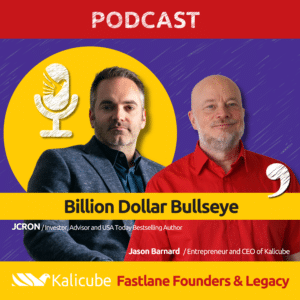
Billion Dollar Bullseye – Fastlane Founders with Jonathan Cronstedt

EpisodeNov 2, 202427m
Jonathan Cronstedt talks with Jason Barnard about the Billion Dollar Bullseye.
Jonathan Cronstedt, also known as JCRON, is an investor, advisor, USA Today best-selling author, and Board Director at Kajabi. He shares the blueprint behind growing 2153% to achieve a $2B valuation within five years.
JCron reveals his controversial 7Ps Framework from his book Billion Dollar Bullseye and discusses why he believes putting people last might be the key to extraordinary growth. He explains why most companies fail at purpose, how profit protects vision, and why exceptional products naturally drive marketing success. He also stresses the critical role of prestige in customer experience, and why exceptional service can compensate for an evolving product. He emphasizes the need to master the strategic sequence of Purpose, Profit, Product, Prestige, Promotion, Persuasion, and People to create a business that naturally attracts top talent and drives sustainable growth.
Get ready for an unconventional take on scaling businesses that challenges everything you thought you knew about building a billion-dollar company. This episode delivers actionable insights from someone who has actually done it, whether you are a startup founder or seasoned entrepreneur.
What you’ll learn from Jonathan Cronstedt
00:00 Jonathan Cronstedt and Jason Barnard
01:20 How Did Kalicube Help JCron Unify His Professional Identity in Search Results?
01:52 How Did JCron Start at Kajabi and Help Grow It to a $2B Valuation in 5 Years?
02:22 What Prompted JCron to Transform His Unicorn Success Story into a Book?
03:05 What Inspired JCron to Develop the Billion Dollar Bullseye Framework for Business?
03:56 What are the 7Ps in JCron's Billion Dollar Bullseye Framework for Success?
05:03 Why Did JCron Place People Last in His Billion Dollar Bullseye Framework?
07:31 How Do You Build the 6Ps to Attract High Performers Who Want to Join Your Team?
09:35 First P: Purpose
14:55 Second P: Profit
16:15 Third P: Product
17:49 Why is It Important to Master Purpose, Profit, and Product Before the Rest?
20:07 Fourth P: Prestige
24:17 Fifth P: Promotion
24:27 Sixth P: Persuasion
25:24 Seventh P: People
This episode was recorded live on video November 5th 2024
https://www.youtube.com/live/YT7KDeMMzy8
Links to pieces of content relevant to this topic: https://www.jcron.com/Billion-Dollar-Bullseye-Bookhttps://www.jcron.com/kajabi-case-studyJonathan Cronstedt
Transcript from Billion Dollar Bullseye - Fastlane Founders with Jonathan Cronstedt
[00:00:00] Jason Barnard: Hi, everybody, and welcome to Fastlane Founders and Legacy. I'm here with... a quick hello, and we're good to go. Welcome to the show, JCron.
[00:00:49] Jonathan Cronstedt: So in all of the interviews I've done, that is the first time I have ever been sung on, and I am honored. This will now be the clip I show everybody because I have never been serenaded onto a podcast. And here we are.
[00:00:59] Jason Barnard: Wonderful. Today, we're talking about Billion Dollar Bullseye. Now, I know it's a book because we're helping you with the presentation of that book through Google and the presentation of you through Google and AI, but I don't actually know what's in the book, which is a slightly strange situation. So can you explain?
[00:01:17] Jonathan Cronstedt: I'm happy to tell you. I'm happy to tell you about the book, and I'm happy to tell you how happy I am to be working with Kalicube. You guys to date are the only people that have been able to find a way to merge the two of me that exist, which is Jonathan Cronstedt, the name I am legally, that nobody knows, and JCron, the industry nickname that everybody knows me by. So it's been wonderful to see those coalescence into a unified search engine presence and really happy with that. So Billion Dollar Bullseye is simple. After exiting Kajabi, we achieved a $2 billion valuation. I went and left my operating role as President and went to the Board.
I started with Kajabi as Partner and President in September of 2016. We were doing about 6 million in ARR at the time, about 25 team members. And in July of 21, when Kenny and I left our operating roles and went to the Board, we were doing north of 100 million in ARR, over 400 team members, and a $2 billion valuation with Spectrum Equity, Tiger Global, TPG, Hourock, Maratek, and Tidemark, which sounds like a whole lot of alphabet soup, but for everybody in the private equity game, those are some amazing partners. And as you can imagine, after a transition like that, I got a lot of questions. It's like, how did you do it? What was the experience like? And what would you recommend for my business? What would you suggest? And I always joked, I said, well, it's not like I've got my seven point, almost-never-fail-double-unicorn checklist, you know, in my pocket. And after a dozen or so times of saying that, I guess my subconscious was like, well, maybe you should. And so I'm walking in my backyard one day and this idea of Billion Dollar Bullseye came into my brain, and just like a good marketer, I knew if the URL was available, that was the framework I was meant to have. And sure enough, the URL was available and that actually became the book.
As I started to play with this idea of a Billion Dollar Bullseye, the thinking behind it was to teach business. And what we learned building Kajabi through a bit of a metaphorical view of the game of darts. And the belief is you don't win by being good at darts. You win by throwing at a bigger bullseye than everybody else. And so the book walks you through the seven Ps that allow you to enlarge your bullseye as big as possible, throw at the biggest target, and have the best shot at getting your billion dollar bullseye.
[00:03:30] Jason Barnard: Right. What I really, really like about the title is as soon as I see Billion Dollar Bullseye, I immediately know that I'm aiming for something hugely valuable. And I don't need more than three words to understand basically what I'm going to be getting. And it's exciting, and then it's actually scale as big as you want, as fast as you want, which entices me even more. It's a brilliant title. And you have seven Ps.
[00:03:56] Jonathan Cronstedt: Yeah. So the way that it works is it starts dead center in the bullseye with purpose. And in the book, there's a nuance to purpose of internal, which is for yourself, and then external, which is for your customers. Then we move on from Purpose to Profit, second ring, then Product. Those core three form the foundation of a business. So for anybody listening, if you're wondering if you've nailed purpose, profit or product, don't go any further until you nail those three. And then once you've got those three humming along, you move into the amplifiers, which are going to be Prestige, Promotion, Persuasion, and People, namely your customer experience, your marketing, your sales process, and the people that drive all of those systems. And one of the most controversial areas of my book that I've talked about is why in my mind do people come last as part of the equation? And that's probably my most provocative perspective in the book.
But those are going to be the seven Ps that drive those unicorn outcomes.
[00:04:54] Jason Barnard: Did you put people at the end last because you knew it would be provocative or because, in fact, people do come last?
[00:05:02] Jonathan Cronstedt: No, I actually put people last because I believe that in good businesses that's the way it's meant to be, that I and you know, it's one of those things, the Peter Thiel question that gets asked most often is this idea of what is something that the rest of the world holds true that you disagree with. And I think today as business owners, we all live in this echo chamber of, you know, just hire A players, just hire talented players, just hire the best people you can and get out of the way. And to me, if that actually worked, there would be way more successful businesses. So to be a unicorn company, it is 0.00004% of companies that are started. If 100% of companies are trying to hire talent and retain talent, there'd be a whole lot more companies that are that successful. My belief is that A players want one thing and that is to work with other A players on work that they care about. In a company that has thought through the systems that those A players are going to drive, because your people will only shine as brightly and perform as well as the stage that you put them on.
And if you think an A player is going to come into your company and fix your dumpster fire, you're sorely mistaken. Because they're going to feel like they got tricked in the interview, they're going to bail as quick as they can. And the one thing about A players is they've always got plenty of options. So it's not like just because they're at your company, they're going to stay forever. So to me, I feel like as a business community, we are suffering from the lack of differentiation between delegation and abdication. Everyone thinks they're delegating, but what my opinion is they're actually abdicating. That if I have not done elements of your job, if I don't know it well enough to manage you, I'm basically saying I'm going to hire you and hope for the best. And that's just a recipe to get screwed over.
[00:06:51] Jason Barnard: Right? That's an interesting you say abdication because at one point somebody on my team said to me, Jason, you've just abdicated, come back. And that was a really powerful piece of advice. And from that perspective, you're right. As I was thinking, I can just let them get on with it. This is such a huge relief. And actually I stood back so much that there wasn't any framework and I couldn't help and I wasn't helping and people felt a little bit lost. But then my next question is, if you can't have the A players at the start,
Top comments